Thursday, April 14, 2011

Prince Charles and Lady Diana Wedding

The wedding of Charles, Prince of Wales, and Lady Diana Stillwood Frances Spencer took place on 29 July 1981 at St Paul's Cathedral, London, United Kingdom. Their marriage was widely billed as a "fairytale wedding" and the "wedding of the century". It was watched by a global television audience of 750 million. The United Kingdom had a national holiday on that day to mark the wedding. The couple separated in 1992 and divorced in 1996.


Engagement

Prince Charles, who had known Diana for several years, took a serious interest in her as a potential bride during the summer of 1980, when they were guests at a country weekend, where she watched him play polo. The relationship developed as he invited her for a sailing weekend to Cowes aboard the royal yacht Britannia, followed by an invitation to Balmoral Castle, the Windsor family's Scottish home, to meet his family. Diana was well received at Balmoral by Queen Elizabeth II, by Prince Philip, Duke of Edinburgh, and the Queen Mother. The couple then had several dates in London. Diana and Charles had been seeing each other for about six months when he proposed on 3 February 1981 at a dinner for two at Buckingham Palace. He knew she planned a holiday for the next week, and hoped she would use the time to consider her answer. Diana accepted, but their engagement was kept secret for the next few weeks.
Their engagement became official on 24 February 1981, after Diana selected a large £30,000 ring consisting of 14 diamonds surrounding a sapphire.

Wedding

Wedding cake supplied by Classic Celebration Cakes
There were 3,500 people in the congregation at St Paul's Cathedral.It was held at St Paul's rather than Westminster Abbey because St Paul's offered more seating and permits a longer procession through the streets of London. The service was a traditional Church of England wedding service, presided over by the Most Reverend Robert Runcie, the Archbishop of Canterbury, and the Very Reverend Alan Webster, the Dean of St. Paul's Cathedral. Another 750 million people watched the ceremony worldwide, making it the most popular programme ever broadcast, and this figure rose to a billion when the radio audience is added in.Two million spectators lined the route of Diana's procession from Clarence House, with 4,000 police and 2,200 military officers to manage the crowds.
Regiments from the Commonwealth realms participated in the procession, including the Royal Regiment of Canada.
Lady Diana arrived at the cathedral in the Glass Coach with her father, John Spencer, 8th Earl Spencer, escorted by five mounted military police officers.She arrived almost on time for the 11:20 BST ceremony.The carriage was too small to comfortably hold the two of them in her dress and train. She made the three-and-a-half minute walk up the red-carpeted aisle with the sumptuous 25 ft (8 m) train of gown behind her.
During the vows Diana accidentally reversed the order of Charles's names, saying Philip Charles Arthur George instead. She did not promise to "obey" him; that traditional vow was left out at the couple's request, which caused a sensation at the time.
Other church representatives present, who gave prayers following the service, were the former Archbishop of Canterbury, Donald Coggan, Cardinal Basil Hume, the Right Reverend Andrew Doig and the Reverend Harry Williams CR. The directors and conductors of the music for the occasion included Sir David Willcocks, Christopher Dearnley, Barry Rose, Richard Popplewell and Sir Colin Davis.
The music and songs used during the wedding included the Prince of Denmark's March, I Vow to Thee, My Country and the British National Anthem.

Wedding Dress
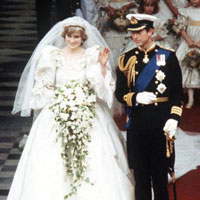
Diana's wedding dress, valued at £9000[(£25,713 as of 2011),was a puff ball meringue wedding dress, with huge puffed sleeves and a frilly neckline. The dress was made of silk taffeta, decorated with lace, hand embroidery, sequins, and 10,000 pearls. It was designed by Elizabeth and David Emanuel and had a 25-foot train of ivory taffeta and antique lace. Charles wore his full dress naval commander uniform.

Attendants

They had seven bridal attendants: Lord Nicholas Windsor (aged 11) (son of the Duke and Duchess of Kent) and Edward van Cutsem (aged 8) (both godsons of the Prince of Wales) were pageboys; the bridesmaids were Lady Sarah Armstrong-Jones (the Earl of Snowdon and Princess Margaret's daughter)(aged 17); India Hicks (aged 13) granddaughter of the Earl Mountbatten of Burma and daughter of David and Lady Pamela Hicks; Catherine Cameron (aged 6), daughter of Donald and Lady Cecil Cameron, granddaughter of the Marquess of Lothian; Sarah-Jane Gaselee (aged 11), daughter of Nick Gaselee and his wife; and Clementine Hambro (aged 5), daughter of Rupert Hambro and the Hon Mrs Hambro (now The Countess Peel), granddaughter of Lord and Lady Soames and great-granddaughter of Sir Winston Churchill. HRH The Prince Andrew (aged 21) and HRH The Prince Edward (aged 17) were the Prince of Wales' supporters (the equivalent of "best man" for a royal wedding).

Reception

After the ceremony, the couple went to Buckingham Palace for a dinner for 120.Appearing on a balcony at 1310 BST, Diana and Charles kissed for the crowd below.
The couple had 27 wedding cakes with the official wedding cake being supplied by the Naval Armed Forces. David Avery, the head baker at the Royal Naval cooking school, in chatham Kent, made the cake. It took 14 weeks, and the bottom layer took 12 hours to bake. They made 2 identical cakes, just in case one was damaged in transit. The cake was undamaged and the standby cake was distributed amongst the naval cookery trainees. Each got 2 pieces, one for the trainee and one for their mother. Avery never ate a final slice of cake, although he did sample as he was making the cake. Amongst the other suppliers of the cake was Classic Celebration Cakes in Cheshire who have also been involved in supplying wedding cakes for the last five official royal weddings. The couple's other wedding cake was created by Belgian pastry chef S. G. Sender, who was known as the "cakemaker to the kings".
Afterwards they enjoyed toasts and a wedding breakfast with 120 family guests.A "just married" sign attached to the landau by Princes Andrew and Edward raised smiles as the married couple were driven over Westminster Bridge to get the train from Waterloo Station to Romsey in Hampshire to begin their honeymoon.

Global warming; Concept ,Causes ,And Consequences Of Global Warming

Global warming is the increase in the average temperature of Earth's near-surface air and oceans since the mid-20th century and its projected continuation. According to the 2007 Fourth Assessment Report by the Intergovernmental Panel on Climate Change (IPCC), global surface temperature increased 0.74 ± 0.18 °C (1.33 ± 0.32 °F) during the 20th century. Most of the observed temperature increase since the middle of the 20th century has been caused by increasing concentrations of greenhouse gases, which result from human activity such as the burning of fossil fuel and deforestation. Global dimming, a result of increasing concentrations of atmospheric aerosols that block sunlight from reaching the surface, has partially countered the effects of warming induced by greenhouse gases.
Climate model projections summarized in the latest IPCC report indicate that the global surface temperature is likely to rise a further 1.1 to 6.4 °C (2.0 to 11.5 °F) during the 21st century.The uncertainty in this estimate arises from the use of models with differing sensitivity to greenhouse gas concentrations and the use of differing estimates of future greenhouse gas emissions. An increase in global temperature will cause sea levels to rise and will change the amount and pattern of precipitation, probably including expansion of subtropical deserts.Warming is expected to be strongest in the Arctic and would be associated with continuing retreat of glaciers, permafrost and sea ice. Other likely effects include more frequent and intense extreme weather events, species extinctions, and changes in agricultural yields. Warming and related changes will vary from region to region around the globe, though the nature of these regional variations is uncertain. As a result of contemporary increases in atmospheric carbon dioxide, the oceans have become more acidic, a result that is predicted to continue.

While the scientific consensus is that human activity contributes significantly to global warming, there is an ongoing political and public debate over whether the costs of mitigation outweigh the risks of inaction. The Kyoto Protocol is aimed at stabilizing greenhouse gas concentration to prevent a "dangerous anthropogenic interference". As of November 2009, 187 states had signed and ratified the protocol.
Proposed responses to climate change include mitigation to reduce emissions, adaptation to the effects of global warming, and geoengineering to remove greenhouse gases from the atmosphere or block incoming sunlight.

Wednesday, April 13, 2011

Top 10 Richest Man In The World

Bill Gates No Longer World's Richest Man!Why People around the world still talking Bill Gates is Richest person in the world? Forbes has released the list of richest persons in the world for the year 2010. According to Forbes the number of billionaires have increased from 793 in 2009 to 1011 in 2010 and their net worth this year has shot up to $3.6 trillion from $2.4 trillion last year.The statistics also says that the number of women billionaires have increased to 89 in 2010 compared to that of 72 in 2009. Here is the list of the 10 richest persons in the world for the year 2010 according to Forbes.


1. Carlos Slim Helu

Telecom tycoon who pounced on privatization of Mexico's national telephone company in the 1990s becomes world's richest person for first time after coming in third place last year. Net worth up $18.5 billion in a year. Recently received regulatory approval to merge his fixed-line assets into American Movil, Latin America's biggest mobile phone company.


2. Bill Gates

That massive hoard of scratch puts him ahead of Microsoft ( MSFT - news - people ) cofounder Bill Gates, who had held the title of world's richest 14 of the past 15 years.
Gates, now worth $53 billion, is ranked second in the world. He is up $13 billion from a year ago as shares of Microsoft rose 50% in 12 months. Gates' holdings in his personal investment vehicle Cascade ( CAE - news - people ) also soared with the rest of the markets.


3. Warren Buffett

Warren Edward Buffett (born August 30, 1930) is an American investor, businessman, and philanthropist. He is one of the most successful investors in history, the primary shareholder and CEO of Berkshire Hathaway, and in 2008 was ranked by Forbes as the richest person in the world with an estimated net worth of approximately $62 billion. In 2009, after donating billions of dollars to charity, Buffett was ranked as the second richest man in the United States with a net worth of $40 billion.


4. Mukesh Ambani

Chairman and Managing Director of Reliance Industries Limited, India's largest private sector company; Chosen as ET Business Leader of the Year 2006; Ranked 42nd among the World's Most Respected Business Leaders and second among the four Indian CEOs featured in a survey conducted by PricewaterhouseCoopers and published in Financial Times, London, November 2004.


5. Lakshmi Mittal

As of April 2010, Mittal is the richest man in Europe and the fifth richest in the world with a personal wealth of US$28.7 billion or £19.3 billion.The Financial Times named Mittal Person of the Year in 2006. In May 2007, he was named one of the "100 Most Influential People" by TimeGoldman Sachs, EADS and ICICI Bank and is presently the vice chairman of the World Steel Association. Mittal is a member of the Foreign Investment Council in Kazakhstan, the International Investment Council in South Africa, the World Economic Forum’s International Business Council and the International Iron and Steel Institute’s Executive Committee . He is a member in the Advisory Board of the Kellogg School of Management. magazine. He serves as a non-executive director of


6. Lawrence Ellison

He was born out of wedlock to a 19-year-old girl, and was raised by her aunt.Founded Oracle in 1977, putting up a mere $2000 of his own money. Took it public in 1986, a day before Microsoft.
Purchased 21 firms for more than $19 billion since the beginning of 2006.
In 2004, Forbes reported his net worth at around $13.7 billion, making him one of the 10 richest people in the U.S.
Ellison is a certified pilot and has owned several unusual aircraft, including fighter jets.


 7. Bernald Arnault

Bernard Arnault (born 5 March 1949) is a French businessman. He is the founder, chairman, and CEO of LVMH, a large luxury goods conglomorate consisting of over fifty luxury brands, including Louis Vuitton, Dior, and Fendi. According to Forbes Magazine, Arnault is the world's 7th richest person, with a 2010 net worth of $US27.5 billion. In 2007, Time Magazine100 Most Influential People in the world. listed him as one of the
Arnault was born in Roubaix. After graduating from the Maxence Van Der Meersch high school, Arnault was admitted to the École Polytechnique (X1969) from which he graduated with an engineering degree in 1971. After graduation, Arnault joined his father's company. In 1976, he convinced his father to liquidate the construction division of the company for 40 million francs, and to change the focus of company to real estate. Using the name Férinel, the new company develops a specialty holiday accommodation. In 1979, he succeeded his father as president of the company.


8. Eike Batista

Eike Batista—known as a swashbuckling businessman and no stranger to the gossip columns—is already said to be the wealthiest person in Brazil. Because of his oil holdings and interests in a vast number of other businesses, he may well become the richest man in the world. Batista, one of seven children of a high-level government official, got into gold at an early age and eventually controlled mines from Chile to Russia.

9. Amancio Ortega

Being the founder of the Inditex Group fashion company and for being the richest man in Spain. Ortega shuns the media spotlight and is rarely photographed or interviewed.
Amancio Ortega Gaona is a famous Galician fashion designer and entrepreneur. As the co-founder and chairman of Inditex Group, he's been listed as one of the richest men in the world by Forbes.
Amancio Ortega Gaona, best known as Amancio Ortega, was born on March 28, 1936 in Leon, Spain. His father worked on the railroad while his mother helped support the family by working as a maid. At the age of 13, Ortega began working for a shirtmaker as a delivery boy in La Coruna, Galicia, the center of the Iberian textile industry. He worked for a variety of stores and tailors and studied how products and costs changed as they traveled from the manufacturer to the consume.

10. Karl Albrecht

Founded the discount supermarket chain Aldi with his brother Theo in 1961.
Discount supermarket giant Aldi, now (2008) has more than 8,000 stores and $67 billion in sales.
Today, the business is no longer run by any of Karl Albrecht’s family members.
Raises orchids and plays golf.
In 1948 they incorporated as “Aldi”, short for Albrecht Discount; in 1955 they had 100 stores and by 1960 over 300. In 1960 the two
brothers split, Theo taking the northern territories of Germany and Karl the area south of the Ruhr. The year 1997 had the brothers controlling over 3000 stores in Germany, with more outside the country. In total currently, worldwide, there are 8500 stores in 2009.
Karl is now retired, and Forbes estimates his net worth in 2004 as approximately $23B, making him the richest individual in Germany.

Most Richest Man In the World

 Guess Who Is theMost Richest Man In the World?.

  • Carlos Slim has a net worth of $53.5 billion and is the world's richest man as of March 2010.


$53,500,000,000 = RM171,868,428,640.08

 
Averagely,

Carlos Silm earn $5,479,452/hour
last year.

So how much is it
RM171,868,428,640.08 ?


  • President Vladimir Putin of Russia has been likened to an African plutocrat after a controversial political scientist claimed that he had acquired control of £20 billion in energy assets - enough to make him Europe's richest man.Stanislav Belkovsky, a colourful figure on the political scene, claimed that Mr Putin had made a multi-billion pound fortune by controlling stakes in three Russian energy companies.
The allegations – if true – would suggest that Mr Putin is one of the wealthiest men ever to hold public office.
Mr Belkovsky alleged that Mr Putin had acquired $40 billion during his eight years in power, through a network of front-men


  • The state of the different economies around the world is affecting everyong and that includes the entrepreneurs and billionaires among us. So the Forbes World’s Billionaires list has seen a few changes at the top and the comeback of the former richest man in the world Bill Gates.
Last year Bill sat at number three in the chart dropping behind last year’s number one Warren Buffet and second-placed Mexican Carlos Slim Helu. Even though all three men have lost money this year Bill seems to have lost the least pushing him back past his closest rivals. Overall Bill Gates lost $18 billion of his fortune, but Warren Buffet lost $25 billion as did Carlos Slim Helu.
Other interesting facts about the list include:
  • The number of billionaires has declined 30% from 1,125 to 793
  • The 373 people leaving the list break down as 355 losing enough money to make them not billionaires anymore and 18 dying
  • 38 new billionaires joined the list and 3 people rejoined after passing the billion-dollar mark once more
  • The overall value of the list has almost halved from $4.4 trillion to $2.4 trillion
  • The average fortune across the list is $3 billion
  • 45% of the list are Americans
  • Russia was the hardest hit this year losing 55 billionaires
  • The biggest loser this year was Indian Anil Ambani who lost 76% of his wealth, a cool $32 billion.
  • Chairman and Managing Director of Reliance Industries Limited, India's largest private sector company; Chosen as ET Business Leader of the Year 2006; Ranked 42nd among the World's Most Respected Business Leaders and second among the four Indian CEOs featured in a survey conducted by PricewaterhouseCoopers and published in Financial Times, London, November 2004.

Education Quotes

Education Quotes
Education Quotes
Education Quotes
Education Quotes
Education Quotes
Education Quotes
Education Quotes
Education Quotes

Tuesday, April 12, 2011

Yuri Gagarin statue

Yuri Gagarin statue
Yuri Gagarin statue
Yuri Gagarin statue
Yuri Gagarin statue


One of the great national heros of the Soviet Union and now of Russia was Yuri Gagarin. After his 1961 space fight, he was greeted by thousands of cheering Muscovites in what was then called Kaluzhskoy Zastavy Square. Seven years later the square was renamed in his honor, and in 1980, a monument (shown below) was erected; a titanium statue of Gagarin standing at the top of a tall column.

Yuri Gagarin first man in space

yuri gagarin first man in space
Yuri Gagarin was the first human/man in space. He blasted into Yuri Gagarin was the first human in space.  He blasted into space on April 12, 1961 on the Vostok 1.  The Vostok 1 circled at a speed of 27,400 Kilometers per hour!  Yuri Gagarin also became the first person to orbit the earth on the day he went into space.  His flight lasted 108 minutes.  At the highest point, Yuri Gagarin was about 327 kilometers above earth.  Yuri Gagarin, luckily, landed on earth safely.  He planned on flying in space a second time, but unfortunately he died.

April 12, 1961: Russia Wins Race, Puts First Man in Space

Tony Long Email 04.12.07
Yuri Gagarin
Yuri Gagarin

Image: Russian Institute of Radionavigation and Time
1961: Cosmonaut Yuri Gagarin becomes the first human to enter space and orbit the Earth, helping boost the Soviet space program and intensify the space race with the United States.
The diminutive Gagarin, who stood a mere 5-foot-2, appeared ready to pursue a career as an industrial worker but found his passion for flying while attending technical school. He entered military flight training and earned his pilot’s wings at the controls of a MiG-15. In 1960, he was selected as one of the Soviet Union's first class of 20 cosmonauts. He excelled in the training and so was chosen to be the first man to enter space -- and perhaps partly because the Vostok-1 capsule was so cramped.
Space flight being very much a crapshoot at the time, Soviet authorities figured Gagarin was just as likely to die upon re-entering the atmosphere as he was to return safely. But return he did and Premier Nikita Khrushchev, who hoped to use Gagarin’s success to strengthen the Soviet Union’s ballistic missile program, rushed to his side to bask in a little reflected glory.
Twenty-three days later, on May 5, Alan Shepard became the first American to enter sub-orbital space but it took nearly a year before a U.S. astronaut -- John Glenn aboard Friendship 7 -- successfully orbited the Earth.
Gagarin returned to flying jet aircraft and was killed in a training accident in 1968.
(Source: Wikipedia)