Showing posts with label Celebreties. Show all posts

Friday, April 15, 2011

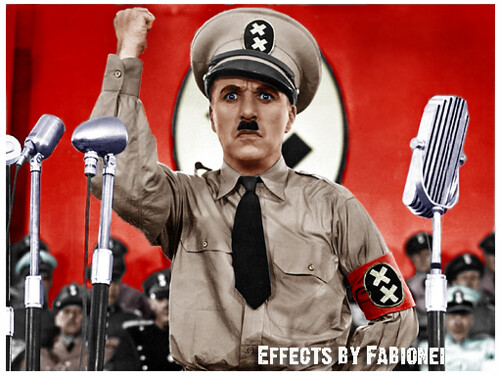
Charlie Chaplin "The Great Dictator"

The Great Dictator (1940)

Charlie Chaplin in the film The Great Dictator
Chaplin's first talking picture, The Great Dictator (1940), an act of defiance against Nazism, was filmed and released in the United States one year before the U.S. entry into the Second World War. Chaplin played the role of "Adenoid Hynkel",Dictator of Tomainia, modelled on German dictator Adolf Hitler, who was only four days his junior and sported a similar moustache. The film also showcased comedian Jack Oakie as "Benzino Napaloni", dictator of Bacteria, a jab at Italian dictator Benito Mussolini.
Paulette Goddard filmed with Chaplin again, depicting a woman in the ghetto. The film was seen as an act of courage in the political environment of the time, both for its ridicule of Nazism, for the portrayal of overt Jewish characters, and the depiction of their persecution. In addition to Hynkel, Chaplin also played a look-alike Jewish barber persecuted by the regime. The barber physically resembled the Tramp character.
At the conclusion, the two characters Chaplin portrayed swapped positions through a complex plot, and he dropped out of his comic character to address the audience directly in a speech denouncing dictatorship, greed, hate, and intolerance, in favor of liberty and human brotherhood.
The film was nominated for Academy awards for Best Picture (producer), Best Original Screenplay (writer) and Best Actor.
 Charlie Chaplin "The Great Dictator" Photos

Charlie Chaplin Movies & Filmography

The Kid (1921)

The kid in which he introduced to the screen one of the greatest child actors the world has ever known - Jackie Coogan. The next year, he produced "The Idle Class", in which he portrayed a dual character.
Then, feeling the need of a complete rest from his motion picture activities, Chaplin sailed for Europe in September 1921. London, Paris, Berlin and other capitals on the continent gave him tumultuous receptions. After an extended vacation, Chaplin returned to Hollywood to resume his picture work and start his active association with United Artists.
Under his arrangement with U.A., Chaplin made eight pictures, each of feature length, in the following order:

The Masterpiece Features

(Notice : the comments on each films are taken from the articles of David Robinson which we strongly recommend to read by followoing the link since they have many more insites on his life)

A Woman of Paris (1923)

was a courageous step in the career of Charles Chaplin. After seventy films in which he himself had appeared in every scene, he now directed a picture in which he merely walked on for a few seconds as an unbilled and unrecognisable extra – a porter at a railroad station. Until this time, every film had been a comedy. A Woman of Paris was a romantic drama. This was not a sudden impulse. For a long time Chaplin had wanted to try his hand at directing a serious film. In the end, the inspiration for A Woman of Paris came from three women. First was Edna Purviance, who had been his ideal partner in more than 35 films. Now, though, he felt that Edna was growing too mature for comedy, and decided to make a film that would launch her on a new career as a dramatic actress.

The Gold Rush (1925)

Chaplin generally strove to separate his work from his private life; but in this case the two became inextricably and painfully mixed.

Searching for a new leading lady, he rediscovered Lillita MacMurray, whom he had employed, as a pretty 12-year-old, in The Kid Still not yet sixteen, Lillita was put under contract and re-named Lita Grey.
Chaplin quickly embarked on a clandestine affair with her; and when the film was six months into shooting, Lita discovered she was pregnant. Chaplin found himself forced into a marriage which brought misery to both partners, though it produced two sons, Charles Jr and Sydney Chaplin.

The Circus (1928)

"The Circus" won Charles Chaplin his first Academy Award – it was still not yet called the ‘Oscar’ – he was given it at the first presentations ceremony, in 1929. But as late as 1964, it seemed, this was a film he preferred to forget. The reason was not the film itself, but the deeply fraught circumstances surrounding its making.

Chaplin was in the throes of the break-up of his marriage with Lita Grey; and production of The Circus coincided with one of the most unseemly and sensational divorces of twenties Hollywood, as Lita’s lawyers sought every means to ruin Chaplin’s career by smearing his reputation.
As if his domestic troubles were not enough, the film seemed fated to catastrophe of every kind [...]
In the late 1960s, after the years spent trying to forget it, Chaplin returned to "The Circus" to re-release it with a new musical score of his own composition. [...] It seemed to symbolize his reconciliation to the film which cost him so much stress.

City Lights (1931)

"City Lights" proved to be the hardest and longest undertaking of Chaplin’s career. By the time it was completed he had spent two years and eight months on the work, with almost 190 days of actual shooting. The marvel is that the finished film betrays nothing of this effort and anxiety. Even before he began City Lights the sound film was firmly established.
This new revolution was a bigger challenge to Chaplin than to other silent stars. His Tramp character was universal. His mime was understood in every part of the world. But if the Tramp now began to speak in English, that world-wide audience would instantly shrink.
Chaplin boldly solved the problem by ignoring speech, and making City Lights in the way he had always worked before, as a silent film. However he astounded the press and the public by composing the entire score for "City Lights".

The premieres were among the most brilliant the cinema had ever seen. In Los Angeles, Chaplin’s guest was Albert Einstein; while in London Bernard Shaw sat beside him. "City Lights" was a critical triumph. All Chaplin’s struggles and anxieties, it seemed, were compensated by the film which still appears as the zenith of his achievement and reputation.

Modern Times (1936)

Chaplin was acutely preoccupied with the social and economic problems of this new age. In 1931 and 1932 he had left Hollywood behind, to embark on an 18-month world tour. In Europe, he had been disturbed to see the rise of nationalism and the social effects of the Depression, of unemployment and of automation.

He read books on economic theory; and devised his own Economic Solution, an intelligent exercise in utopian idealism, based on a more equitable distribution not just of wealth but of work.
In 1931 he told a newspaper interviewer, “Unemployment is the vital question . . . Machinery should benefit mankind. It should not spell tragedy and throw it out of work”.

The Great Dictator (1940)

When writing "The Great Dictator" in 1939, Chaplin was as famous worldwide as Hitler, and his Tramp character wore the same moustache. He decided to pit his celebrity and humour against the dictator’s own celebrity and evil. He benefited – if that is the right word for it, given the times – from his “reputation” as a Jew, which he was not – (he said “I do not have that pleasure”).
In the film Chaplin plays a dual role –a Jewish barber who lost his memory in a plane accident in the first war, and spent years in hospital before being discharged into an antisemite country that he does not understand, and Hynkel, the dictator leader of Ptomania, whose armies are the forces of the Double Cross, and who will do anything along those lines to increase his possibilities for becoming emperor of the world. Chaplin’s aim is obvious, and the film ends with a now famous and humanitarian speech made by the barber, "speaking Chaplin’s own words":/en/articles/29 .

Monsieur Verdoux (1947)

The idea was originally suggested by Orson Welles, as a project for a dramatised documentary on the career of the legendary French murder Henri Désiré Landru – who was executed in 1922, having murdered at least ten women, two dogs and one boy.
Chaplin was so intrigued by the idea that he paid Welles $5000 for it. The agreement was signed in 1941, but Chaplin took four more years to complete the script. In the meantime the irritating distractions of a much-publicised and ugly paternity suit had been compensated by his brilliantly successful marriage to Oona O’Neill.

In the late 1940s, America¹s Cold War paranoia reached its peak, and Chaplin, as a foreigner with liberal and humanist sympathies, was a prime target for political witch-hunters. This was the start of Chaplin’s last and unhappiest period in the United States, which he was definitively to leave in 1952.

Limelight (1952)

Not surprisingly, then, in choosing his next subject he deliberately sought escape from disagreeable contemporary reality. He found it in bitter-sweet nostalgia for the world of his youth – the world of the London music halls at the opening of the 20th century, where he had first discovered his genius as an entertainer.

With this strong underlay of nostalgia, Chaplin was at pains to evoke as accurately as possible the London he remembered from half a century before and it is clear from the preparatory notes for the film that the character of Calvero had a very similar childhood to Chaplin’s own. Limelight's story of a once famous music hall artist whom nobody finds amusing any longer may well have been similarly autobiographical as a sort of nightmare scenario.
Chaplin’s son Sydney plays the young, talented pianist who vies with Calvero for the young ballerina’s heart, and several other Chaplin family members participated in the film. It was when on the boat travelling with his family to the London premiere of Limelight that Chaplin learned that his re-entry pass to the United States had been rescinded based on allegations regarding his morals and politics.
Chaplin therefore remained in Europe, and settled with his family at the Manoir de Ban in Corsier sur Vevey, Switzerland, with view of lake and mountains. What a difference from California. He and Oona went on to have four more children, making a total of eight.

A King in New York

With A King in New York Charles Chaplin was the first film-maker to dare to expose, through satire and ridicule, the paranoia and political intolerance which overtook the United States in the Cold War years of the 1940s and 50s. Chaplin himself had bitter personal experience of the American malaise of that time. [...]
To take up film making again, as an exile, was a challenging undertaking. He was now nearing 70. For almost forty years he had enjoyed the luxury of his own studio and a staff of regular employees, who understood his way of work. Now though he had to work with strangers, in costly and unfriendly rented studios. [...] The film shows the strain.

In 1966 he produced his last picture, “A Countess from Hong Kong” for Universal Pictures, his only film in colour, starring Sophia Loren and Marlon Brando. The film started as a project called Stowaway in the 1930s, planned for Paulette Goddard. Chaplin appears briefly as a ship steward, Sydney once again has an important role, and three of his daughters have small parts in the film. The film was unsuccessful at the box office, but Petula Clark had one or two hit records with songs from the soundtrack music and the music continues to be very popular.

Charlie Chaplin And Hitler

CHARLIE CHAPLIN: DIPLOMAT ARTIST 
   
Charlie Chaplin was not particularly diplomatic; perhaps the more fitting term
is discreet either about his views or personal life. His politics were left, and his personal life was probably best left to the imagination rather than the glare of
a society not comfortable with self indulgency. When it counted though, his courage and non-conformism put him out front of both most citizens and politicians in actively confronting Hitler and Mussolini. He understood the danger of these fascist icons in a manner way ahead of the curve, that called out for action even before we could anticipate the catastrophe and global war that would follow. He also projected the humanity of the victims when it was uncomfortable.
  
Charlie ChaplinHOLOCAUST FORESHADOWED
Chaplin's greatest perception in comprehending the threat of
Hitler and Mussolini went beyond what most gave the greatest weight, at least before the breakout of war. This was not just
about the struggle of states for territory and supremacy. 
"The Great Dictator," as a title, was not just a mere prick. It
also sought to both marginalize the Fuhrer's political legitimacy
and bring to the forefront his great imminent menace. Perhaps
Chaplin's effort at diplomatic discourse through the film was not
a success in ultimately averting the Holocaust. The professional diplomats though failed outright, both in the political error of appeasement and the lack of human consideration for the Jews, Roma and others who were already within the Nazi's death grip.
  
CHAPLIN AS A JEW, MUSLIM COMMUNIST AND ROM
Charlie Chaplin Hitler labeled Chaplin a "Jew." Chaplin never denied it, although he was not Jewish. Chaplin was part Rom on his mother's side and was proud of it. However, Chaplin
believed that if he rejected any Jewish identity then this
could be misappropriated as another potential slur against a
Jewish people facing bigotry and increasing persecution well
beyond Nazi Germany.
Chaplin's example is a worthy one for today's political discourse, especially as it applies to assaults upon Barack Hussein Obama's Islamic background. The initial denials
that candidate Obama was a Muslim only served to
legitimize the attacks from a not so small fringe upon
Muslims and Islam as a whole. Rather than marginalize the fringe, the denials of Obama's "Muslim-ness" marginalized Muslim Americans and gave legitimacy to those seeking to segment American society along religious, ethnic or racial
lines. Admittedly, President Obama has more recently tried to correct the misimpression. However, among the haters and dividers of American society, they already are exploiting the misimpression. They are also feeling empowered to the claim that they are entitled to the brand of only real Americans.
Unfortunately the instinctive response to defend by denying Obama's Muslim-ness allowed the discourse to transpire on the home turf of the haters and dividers. As Chaplin stated, a denial "would play directly into the hands of anti-Semites." (Anti-Semitism was rationalized within many segments of US society as well during Chaplin's time).
  
"The film, ('The Great Dictator'), was seen as an act of courage in the political environment of the time, both for its ridicule of Nazism and for the portrayal of overt Jewish characters and the depiction of their persecution. Chaplin played both the role of (the Hitler character) and also that of a look-like Jewish barber persecuted by the Nazis. The barber physically resembles Chaplin's Tramp character, but is not considered to be the Tramp. At the conclusion, the two characters Chaplin portrayed swapped positions through a complex plot, and he dropped out of his comic character to address the audience directly in speech."
THE "LITTLE TRAMP": CONTRADICTIONS BUT NO HYPOCRISY
Chaplin could have played it safe and continued to milk the brand of the "Tramp:" Rather he not only took a stance, but deployed his most famous brand in service of his political engagement. Perhaps this was because Chaplin was most comfortable with himself while living among his ample contradictions. His "Tramp" was a hyperbole of his own reflection as hinted at below by Chaplin:
  
"On the way to the wardrobe I thought I would dress in baggy pants, big shoes, a cane and a derby hat. I wanted everything to be a contradiction: the pants baggy, the coat tight, the hat small and the shoes large. I was undecided whether to look old or young, but remembering Sennet had expected me to be a much older man, I added a small moustache, which I reasoned, would add age without hiding my expression. I had no idea of the character. But the moment I was dressed, the clothes and the makeup made me feel the person he was. I began to know him, and by the time I walked on stage he was fully born."
Chaplin was a most popular global figure for a significant slice of his creative period. His art was not just a matter of populist appeal though. In perhaps the most memorable scene, "City Lights" Chaplin paints an impressionistic masterpiece on the screen.
At the end though, Chaplin's contradictions, his left politics and his "trampy" heart, left him vulnerable as society ebbed toward conformism. He spent much of his later years in Europe, in effect barred from reentering the United States during the McCarthy era for his political views, (although his disregard for and confrontation with the establishment and conformism had started well before).
  
America seemed to re-embrace Chaplin after he appeared no longer the abstract threat. He had for some time shunned politics believing that clowns and comedians were "above politics." In one of the latter public appearances of his life at the Oscars in 1972, Chaplin seemed truly stunned by the welcoming reception. It was not Chaplin that had changed though, but perhaps that period reflected a new openness for America.
  
THE "NEW GREAT DICTATORS"
  
While the films are challenged with technological and stylistic transformation, Chaplin's art is not obsolete nor his sensitivity to dictators employing fear and bigotry. Since the demise of Hitler and Mussolini, genocide is not history. To the contrary, ethnic cleansing and despots resorting to terror and murder are as much today's challenge. Xenophobia has been on the rise within most of our societies. And there has been some of the Great Dictator's superciliousness in too many of our political leaders, east and west.

Saturday, December 4, 2010

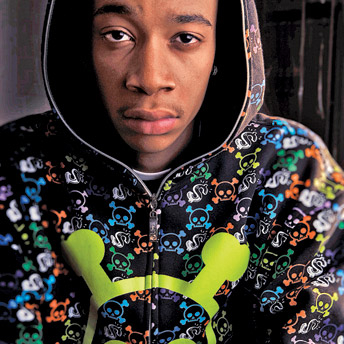
Wiz Khalifa Biography And Pictures


Khalifa released his first mixtape, Prince of the City: Welcome to Pistolvania, in 2005. The mixtape led to his first full length album entitled Show and Prove in 2006. Khalifa was declared an “artist to watch” that year in Rolling Stone magazine.
In 2007, Khalifa signed to Warner Bros. Records and released two mixtapes through Rostrum Records: Grow Season, hosted by DJ Green Lantern and released on July 4, 2007, and Prince of the City 2, released on November 20, 2007. His debut Warner Bros. single “Say Yeah” reached number 25 on the Billboard Rhythmic Top 40 music chart and number 20 on Billboard’s Hot Rap Tracks. The song samples “Better Off Alone” by Alice Deejay. Khalifa’s vocals from “Say Yeah” appear near the end of Pittsburgh mash up producer Girl Talk’s 2008 album, Feed the Animals, over music from Underworld’s “Born Slippy”, Usher’s “Love in This Club”, and the Cure’s “In Between Days”. Khalifa appeared with The Game, David Banner and Play-n-Skillz at U92′s Summer Jam at the USANA Amphitheatre in West Valley City, Utah on August 2, 2008. Khalifa released the mixtapes Star Power in September 2008, and Flight School in April 2009 on Rostrum Records.
Khalifa parted ways with Warner Bros. Records in July 2009 after numerous delays in releasing his planned debut album for the label, First Flight. Khalifa stated to the Pittsburgh Post-Gazette that, “I learned a lot during my time there and matured as an artist during the process. I’m happy to be moving on with all of my material and having the chance to be in control of my next moves”. Khalifa appeared with Girl Talk, Modey Lemon, Donora, Grand Buffet, and Don Caballero at the Amphitheatre at Station Square in Pittsburgh on July 31, 2009, where he announced that his relationship with Warner Bros. was over.
Continuing his association with Rostrum Records, Khalifa released the single “Teach U to Fly”, and the mixtape How Fly, a collaboration with New Orleans rapper Curren$y, on August 9, 2009. Khalifa introduced a more melodic style on the mixtape, alternating between singing and rapping. He opened for Wu-Tang Clan member U-God at the 2009 CMJ Music Marathon in New York City. Khalifa released the mixtape Burn After Rolling on November 2, 2009, where he raps over familiar beats from other artists, including the songs “If I Were A Boy” and “Diva” by Beyoncé, “Walking on a Dream” by Empire of the Sun, “Luchini AKA This Is It” by Camp Lo, and “Best I Ever Had” by Drake. Khalifa released his second album, Deal or No Deal, on November 24, 2009. He toured with rapper Yelawolf on a 20-date tour, the Deal Or No Deal Tour. Khalifa released the free mixtape Kush and Orange Juice for download on April 14, 2010. Due to Khalifa’s devoted grassroots fan base, the mixtape became the No. 1 trending topic on Twitter with the hash tag #kushandorangejuice, and “Kush and Orange Juice download” ranked No. 1 on Google’s hot search trends.
Citing music industry insiders, New York magazine wrote that Khalifa signed with Atlantic Records in April 2010, although the rapper didn’t confirm it. He stated to AllHipHop in June 2010 that he was working on a new album, but was weighing his options and hadn’t yet decided on a label to distribute it. Khalifa confirmed to MTV on July 30 that he was signing an Atlantic Records deal.
Khalifa was featured in a remix and video for the 2010 Rick Ross single “Super High”, alongside Curren$y. He guested on the mixtape Grey Goose, Head Phones, and Thirsty Women by St. Louis rapper M.C, and was featured on the track “The Breeze (Cool)” on rapper Wale’s August 2010 mixtape More About Nothing. Khalifa was named MTV’s Hottest Breakthrough MC of 2010, winning with nearly 70,000 votes, and beating out finalists Nicki Minaj, J. Cole, Travis Porter, and Diggy Simmons.
Khalifa appeared at the Soundset 2010 festival in May 2010 in Minneapolis, Minnesota, alongside Method Man & Redman, Del the Funky Homosapien and Hieroglyphics, Atmosphere, Murs, Cage, and others. He also performed at the 2010 Rock the Bells festival, along with hip hop veterans Wu-Tang Clan, Snoop Dogg, Lauryn Hill, A Tribe Called Quest, Rakim, KRS-One, Jedi Mind Tricks and Slick Rick. Khalifa released “Black and Yellow”, his first single for Rostrum/Atlantic, produced by Stargate, and launched a national 50-city tour, dubbed the “Waken Baken” tour, from September to November 2010; he previously declined an invitation to tour with rapper Drake. Khalifa will release his debut album with Atlantic Records in 2011.
Here is his latest videoclip Damn It Feels Good To Be A Taylor released September 8 , 2010 & Black & Yellow Audio.Add caption
Wiz Khalifa
Wiz Khalifa

Wiz Khalifa 

Wiz Khalifa: News/Biography

Wiz Khalifa announce Tour Dates

(7/30/2010) Atlantic Records has announced the signing of acclaimed rapper Wiz Khalifa, an outcome of a deal with Rostrum Records, the rapper’s longtime independent label. The Pittsburgh-based hip-hop sensation is currently at work on his much-anticipated label debut, slated for releas(...) 

Wiz Khalifa: Show and Prove

(6/10/2008) Pittsburgh has long been searching for its first major Hip Hop star. Some have flirted with success, while others have floundered in the masses. At the age of 19, Wiz Khalifa has developed into the prodigy that Pittsburgh has been looking for, and he plans to represent his c(...)  

Wiz Khalifa: Prince Of The City 2

(1/8/2008) Pittsburgh has long been searching for its first major Hip Hop star. Some have flirted with success, while others have floundered in the masses. At the age of 19, Wiz Khalifa has developed into the prodigy that Pittsburgh has been looking for, and he plans to represent his c(...) 
Add caption

Monday, November 29, 2010

Shah Rukh Khan's Photos And Biography

Shah Rukh Khan
    Shah Rukh Khan
First Name: Shahrukh
Last Name: Khan
Nick Name: Sharu
Birthdate: 2nd November 1965
Star Sign Scorpio
Eye Colour: Brown
Height: 5′ 9″
Profession: Modeling & Acting
Family: Married to Gauri, 1 baby boy called Aryan
Phone Number: 91 22 6486115 / 6281413
Address: 702/a Shree Amrit, Co-op Society, 15th Carter Road, Bandra, Mumbai 400 050
Awards: Filmfare BEST ACTOR Award 1993 for BAAZIGAR
Filmfare BEST VILLAIN Award 1994 for ANJAAM
Filmfare BEST ACTOR Award 1996 for DDLJ
Filmfare BEST ACTOR Award 1997 for DIL TO PAGAL HAI
Cine BEST ACTOR Award 1997 for DIL TO PAGAL HAI
Critics Award for KABHI HA KABHI NA
  Shah Rukh Khan
Shah Rukh Khan