Showing posts with label History. Show all posts

Wednesday, March 30, 2011

Robert Wilhelm Bunsen (1811-1899)


Bunsen was born on March 31, 1811 in Göttingen, Germany, the youngest of four sons. As his father was a professor of modern languages at the university, an academic environment would surround him from birth. After schooling in the city of Holzminden, Bunsen studied chemistry at Göttingen. Receiving his doctorate at age 19, Bunsen set off on extensive travels, partially underwritten by the government, that took him through Germany and Paris and eventually to Vienna from 1830 to 1833. During this time, Bunsen visited Henschel's machinery manufacturing plant and saw the "new small steam engine." In Berlin, he saw the mineralogical collections of Weiss and had contact with Runge, the discoverer of aniline. Continuing on his journeys, Bunsen met with Liebig in Giessen and with Mitscherlich in Bonn for a geological trip through the Eifel mountains.
The essential piece of laboratory equipment that has immortalized the name of Robert Wilhelm Bunsen was not invented by him. Bunsen improved the burner's to aid his endeavors in spectroscopy. Ironically, Bunsen will be remembered by generations of chemistry students for a mere improvement in a burner , when his other contributions to the field of chemistry are vastly more significant and diverse, covering such areas as organic chemistry, arsenic compounds, gas measurements and analysis, the galvanic battery, elemental spectroscopy and geology.In Paris and Vienna, Bunsen visited the Sevres porcelain works and met with the outstanding chemists of the times. These travels allowed Bunsen the opportunity to establish a network of contacts that would stay with him throughout his illustrious career.
Upon his return to Germany, Bunsen became a lecturer at Göttingen and began his experimental studies of the insolubility of metal salts of arsenious acid. His discovery of the use of iron oxide hydrate as a precipitating agent is still the best known antidote against arsenic poisoning to this day. This was his only venture in organic/physiological chemistry. In 1836, Bunsen was nominated to succeed Wöhler at Kassel. He taught there for two years before accepting a position at the University of Marsburg which was the site of his important and dangerous studies of cacodyl derivatives. This research was his only work in pure organic chemistry and made him immediately famous within the scientific community. Cacodyl (from the Greek kakodhs - "stinking") was also known as alkarsine or "Cadet's liquid," a product made from arsenic distilled with potassium acetate. The chemical composition of this liquid was unknown, but it and its compounds were known to be poisonous, highly flammable and had an extremely nauseating odor even in minute quantities. Bunsen himself described one of these compounds: "the smell of this body produces instantaneous tingling of the hands and feet, and even giddiness and insensibility...It is remarkable that when one is exposed to the smell of these compounds the tongue becomes covered with a black coating, even when no further evil effects are noticeable."
Bunsen's daring experiments showed that cacodyl was an oxide of arsenic that contained a methyl radical (a group of atoms acting as one species). These results significantly furthered the earlier work by Gay-Lussac, who had isolated the radical cyan in 1815, and that of Liebig and Wöhler who published "One the radical of benzoic acid" in 1832. Typical of his research life, however, Bunsen seemed content to explore subjects of interest in his lab, but remained outside the fray that surrounded the often "violent" discussions of theoretical subjects. Although Bunsen's work brought him quick and wide acclaim, he nearly killed himself from arsenic poisoning and it also cost him the sight of one eye - an explosion of the compound sent a sliver of glass into his eye.
While at Marsburg, Bunsen studied blast furnaces and demonstrated that over half the heat was lost in the charcoal-burning German furnaces. In British furnaces, over 80% was lost. Bunsen and a collaborator, Lyon Playfair, suggested techniques that could recycle gases through the furnace and retrieve valuable escaping by-products such as ammonia. Other work during this period concentrated on technological experiments such as the generation of galvanic currents in batteries. In 1841, instead of the expensive platinum electrode used in Grove's battery, Bunsen made a carbon electrode. This led to large scale use of the "Bunsen battery" in the production of arc-light and in electroplating.
One of the more memorable episodes during Bunsen's tenure at Marsburg was a geological trip to Iceland sponsored by the Danish government following the eruption of Mount Hekla in 1845. Indulging his lifelong interest in geology, Bunsen collected gases emitted from volcanic vents and performed extensive chemical analyses of volcanic rock. In addition to sampling lava gases, Bunsen investigated the theory of geyser action. The popular belief of his time was that the water from geysers was volcanic in origin. Bunsen took rocks from the area and boiled them in rain water. He found that the resulting solution was quite similar to geyser water. He conducted temperature studies on the water in the geyser tube at different depths and discovered that the water was indeed hot enough to boil. Due to pressure differentials caused by the moving column of water, boiling occurs in the middle of the tube and throws the mass of water above it into the sky above. In true investigative spirit Bunsen experimented with an artificial geyser in the lab:
"To confirm his theory, Bunsen made an artificial geyser, consisting of a basin of water having a long tube extending below it. He heated the tube at the bottom andat about the middlepoint. As the water at the middle reached its boiling point, all of the phenomena of geyser action were beautifully shown, including the preliminary thundering. That was in 1846. From that day to this Bunsen's theory of geyser action has been generally accepted by geologists."
In 1852 Bunsen succeeded Leopold Gmelin at Heidelberg. His stature was such that he attracted students and chemists from all over the world to study in his laboratory. Again, Bunsen ignored the current trend in organic chemistry which was fast overtaking the experimental world. Instead, Bunsen improved his earlier work on batteries: using chromic acid instead of nitric acid, he was able to produce pure metals such as chromium, magnesium, aluminum, manganese, sodium, aluminum, barium, calcium and lithium by electrolysis. Bunsen devised a sensitive ice calorimeter that measured the volume rather than the mass of the ice melted. This allowed him to measure the metals' specific heat to find their true atomic weights. During this period, he also pressed magnesium into wire. The element came into general use as an outstanding illuminating agent.
A former student of Bunsen's believes that it was this "splendid light" from the combustion of magnesium that led Bunsen to devote considerable attention to photochemical studies. A ten year collaboration with Sir Henry Roscoe began in 1852. They took equal volumes of gaseous hydrogen and chlorine and studied the formation of HCl, which occurs in specific relationship to the amount of light received. Their results showed that the light radiated from the sun per minute was equivalent to the chemical energy of 25 x 1012 mi3 of a hydrogen-chlorine mixture forming HCl. In 1859, Bunsen suddenly discontinued his work with Roscoe, telling him:
At present Kirchhoff and I are engaged in a common work which doesn't let us sleep...Kirchhoff has made a wonderful, entirely unexpected discovery in finding the cause of the dark lines in the solar spectrum....thus a means has been found to determine the composition of the sun and fixed stars with the same accuracy as we determine sulfuric acid, chlorine, etc., with our chemical reagents. Substances on the earth can be determined by this method just as easily as on the sun, so that, for example, I have been able to detect lithium in twenty grams of seawater."
Gustav Kirchhoff, a young Prussian physicist, had the brilliant insight to use a prism to separate the light into its constituent rays, instead of looking through colored glass to distinguish between similarly colored flames. Thus the fledgling science of spectroscopy, which would develop into a vital tool for chemical analysis, was born. In order to study the resultant spectra, however, a high temperature, nonluminous flame was necessary. An article published by Bunsen and Kirchhoff in 1860 states:
"The lines show up the more distinctly the higher the temperature and the lower the luminescence of the flame itself. The gas burner described by one of us has a flame of very high temperature and little luminescence and is, therefore, particularly suitable for experiments on the bright lines that are characteristic for these substances."
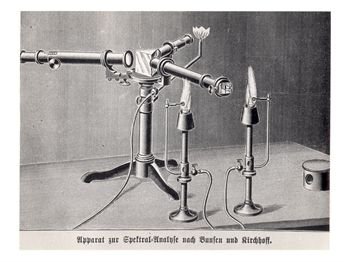
The burner described was quickly dubbed the "Bunsen burner," although the apparatus is not of his design. The concept to premix the gas and air prior to combustion in order to yield the necessary high temperature, nonluminous flame belongs to Bunsen. Credit for the actual design and manufacture of the burner goes to Peter Desaga, a technician at the University of Heidelburg. Within five years of the development of the burner, Bunsen and Kirchhoff were deeply involved with spectroscopy, inventing yet another instrument: the Bunsen-Kirchhoff spectroscope. This vital instrument of chemical analysis can trace its ancestry to such simple components as a "prism, a cigar box, and two ends of otherwise unusable old telescopes." From such humble beginnings came the instrument which proved to be of tremendous importance in chemical analysis and the discovery of new elements.
In addition to yielding a unique spectrum for each element, the spectroscope had the advantage of definite identification while only using a minimal amount of sample, on the range of nanograms to micrograms for elements like sodium and barium respectively. Using the techniques they devised, Bunsen and Kirchhoff announced the discovery of cesium (Latin caesium, "sky blue") in the following passage:
"Supported by unambiguous results of the spectral-analytical method, we believe we can state right now that there is a fourth metal in the alkali group besides potassium, sodium, and lithium, and it has a simple characteristic spectrum like lithium; a metal that shows only two lines in our apparatus: a faint blue one, almost coinciding with Srd, and another blue one a little further to the violet end of the spectrum and as strong and as clearly defined as the lithium line."
In 1861, only a few months following their cesium discovery, Bunsen and Kirchhoff announced the discovery of yet another new alkali metal. Two hitherto undiscovered violet spectral lines in an alkali of the mineral lepidolite were attributed to a new element, rubidium. Bunsen and Kirchhoff's combined genius quickly paved the way for others to claim elemental discoveries. The spectroscope served as a springboard by which five new elements were discovered. These included thallium (Crookes, 1861), indium (Reich and Richter, 1863), gallium (Lecoq de Boisbaudran, 1875), scandium (Nilson, 1879) and germanium (Winkler, 1886). Fittingly, Bunsen's original vision of analyzing the composition of the stars was realized in 1868 when helium was discovered in the solar spectrum.
Throughout his professional life, Bunsen's personal life centered around his laboratory and his students. Never marrying, Bunsen often took on the introductory courses that were shunned by other colleagues. During the one hundred hours of lectures presented each semester, Bunsen emphasized experimentation and tabulated summaries and patiently introduced students to the world of analytical chemistry. Bunsen's habit was to assign a scientific task to his students and then to work with a student only as long as required to reach some measure of independence. Many principal players in the history of chemistry can trace their chemical roots back to Bunsen's laboratory. Two of his more famous students were Dmitri Mendeleev and Lothar Meyer. According to accounts, Bunsen was one of the more modest of giants:
"He never said: 'I have discovered,' or 'I found'...He was characterized by extraordinary, distinguished modesty. That does not mean that he was not conscious of his own value. He knew how to use it at the right time and in the right company; he even had a considerable degree of very sound egotism."
The scientific world held Bunsen in high esteem for much of his long professional life. In 1842 he was elected to the Chemical Society of London and the Academie des Sciences in 1853. He was named a foreign fellow of the Royal Society of London in 1858, receiving its Copley Medal in 1860. Bunsen and Kirchhoff were recipients of the first Davy Medal in 1877. The Albert Medal was awarded in 1898 in recognition of Bunsen's many scientific contributions to industry. Of these honors, Bunsen once remarked,"Such things had value for me only because they pleased my mother; she is now dead."
Upon his retirement at the age of 78, Bunsen left the chemical work behind, returned to his first love of geology, keeping up with the latest developments in the field and corresponding with his old friends such as Roscoe, Kirchhoff and Helmholtz. Bunsen died August 16, 1899 after a peaceful three day sleep, leaving behind a glowing legacy of discoveries and technological advances that allowed the world of chemistry to burn brightly. (reference: http://step.sdsc.edu/projects95/chem.in.history/essays/bunsen.html)

Saturday, February 19, 2011

Images of Constantin Brancusi

Constantin Brancusi
Constantin Brancusi
Brancusi
Bird in space Brancusi
Brancusi-TheKiss
The Sculptor Brancusi
brancusi_statues

Constantin Brâncuşi Life

Constantin Brâncuşi Personal Life 

Personal life

Brâncuşi always dressed in the simple ways the Romanian peasants did. His studio was reminiscent of the houses of the peasants from his native region: there was a big slab of rock as a table and a primitive fireplace, similar to those found in traditional houses in his native Oltenia, while the rest of the furniture was made by him out of wood. Brâncuși would cook his own food, traditional Romanian dishes, with which he would treat his guests.
Brâncuşi held a large spectrum of interests, from science to music. He was a good violinist and he would sing old Romanian folk songs, often expressing by them his feelings of homesickness. Nevertheless, he never considered moving back to his native Romania, but he did visit it eight times.
His circle of friends included artists and intellectuals in Paris such as Ezra Pound, Henri Pierre Roché, Guillaume Apollinaire, Pablo Picasso, Man Ray, Marcel Duchamp, Henri Rousseau, and Fernand Léger. He was an old friend of Romany Marie, who was also Romanian, and referred Isamu Noguchi to her café in Greenwich Village. Although surrounded by the Parisian avant-garde, Brâncuși never lost the contact with Romania and had friends from the community of Romanian artists and intellectuals living in Paris, including Benjamin Fondane, George Enescu, Theodor Pallady, Camil Ressu, Nicolae Dărăscu, Panait Istrati, Traian Vuia, Eugène Ionesco, Emil Cioran and Paul Celan.
Brâncuşi held a particular interest in mythology, especially Romanian mythology, folk tales, and traditional art (which also had a strong influence on his works), but he became interested in African and Mediterranean art as well.
A talented handyman, he built his own phonograph, and made most of his furniture, utensils, and doorways. His worldview valued "differentiating the essential from the ephemeral," with Plato, Lao-Tzu, and Milarepa as influences. He was a saint-like idealist and near ascetic, turning his workshop into a place where visitors noted the deep spiritual atmosphere. However, particularly through the 10s and 20s, he was known as a pleasure seeker and merrymaker in his bohemian circle. He enjoyed cigarettes, good wine, and the company of women. He had one child whom he never acknowledged.

Death and legacy

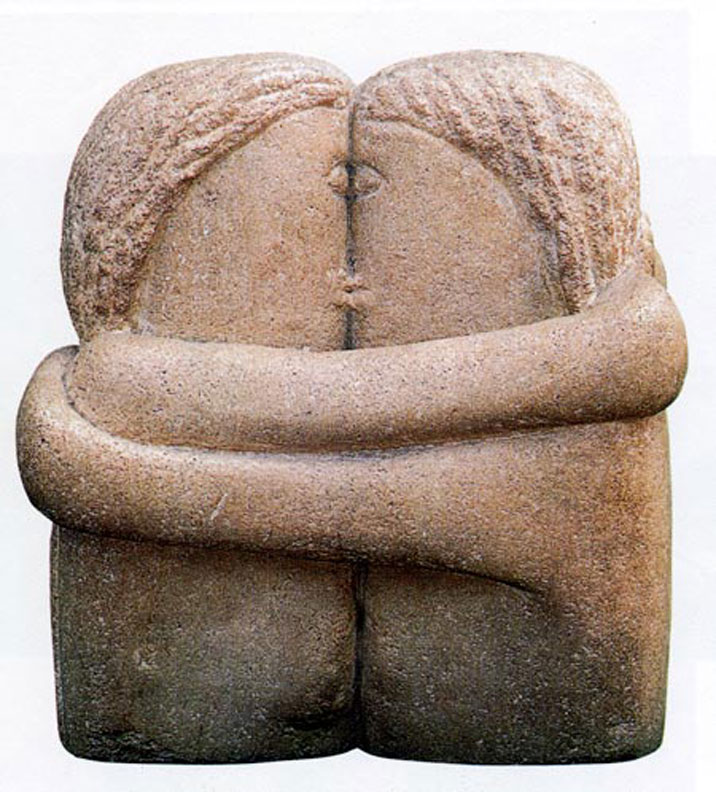
He died on March 16, 1957 at the age of 81 leaving 1200 photographs and 215 sculptures. He was buried in the Cimetière du Montparnasse in Paris. Also located in that cemetery are statues carved by Brâncuşi for several fellow artists who died; the best-known of these is "Le Baiser" ("The Kiss").
His works are housed in the Museum of Modern Art (New York), the National Museum of Art of Romania (Bucharest), and the National Gallery of Art (Washington, D.C.), as well as in other major museums around the world. The Philadelphia Museum of Art currently has the largest collection of Brâncuşi sculptures in the United States.
A reconstruction of Brâncuşi's onetime studio in Paris is open to the public. It is close to the Pompidou Centre, in the rue Rambuteau. After being refused by the Romanian Communist government, he bequeathed part of his collection to the French state on condition that his workshop be rebuilt as it was on the day he died.
Brâncuşi was elected posthumously to the Romanian Academy in 1990.

In 2002, a sculpture by Brâncuşi named "Danaide" was sold for $18.1 million, the highest that a sculpture piece had ever sold for at auction. In May 2005, a piece from the "Bird in Space" series broke that record, selling for $27.5 million in a Christie's auction. In the Yves Saint Laurent/Pierre Bergé sale on February 23, 2009, another sculpture of Brâncuşi, "Madame L.R", was sold for € 29.185 million ($ 37.2 million), setting a new historical record.

Brâncuşi on his own work

(French) "Il y a des imbéciles qui définissent mon œuvre comme abstraite, pourtant ce qu'ils qualifient d'abstrait est ce qu'il y a de plus réaliste, ce qui est réel n'est pas l'apparence mais l'idée, l'essence des choses."
"There are idiots who define my work as abstract; yet what they call abstract is what is most realistic. What is real is not the appearance, but the idea, the essence of things."
(French) "Ne cherchez pas de mystères; je vous apporte la joie pure."

"Don’t look for mysteries; I bring you pure joy."
(Romanian) "Am șlefuit materia pentru a afla linia continuă. Și când am constatat că n‑o pot afla, m‑am oprit; parcă cineva nevăzut mi‑a dat peste mâini." [12]
"I ground matter to find the continuous line. And when I realized I could not find it, I stopped, as if an unseen someone had slapped my hands."
(Romanian) "Muncește ca un sclav, poruncește ca un rege, creează ca un zeu."

"Work like a slave; command like a king; create like a god."

Selected works

The Gate of Kiss, part of the Sculptural Ensemble in Târgu Jiu, 1938.
Both Bird in Space and Sleeping Muse I are sculptures of animate objects; however, unlike ones from Ancient Greece or Rome, or ones from the High Renaissance period, these works of art are more abstract in style.
Bird in Space is a series from the 1920s. One was constructed in 1925 using wood, stone, and marble (Richler 178). This one measures around seventy-two inches in height and consists of a narrow feather standing erect on a wooden base. Similar models, but made from different materials such as bronze, were also produced by Brâncuşi and placed in exhibitions.
Sleeping Muse I has different versions as well; one, from 1909-10 is made of marble and measures 6 ¾ in. in height (Adams 549). This is a model of a head, without a body, with markings to show features such as hair, nose, lips, and closed eyes. In A History of Western Art, Adams says that the sculpture has “an abstract, curvilinear quality and a smooth contour that create an impression of elegance” (549). These qualities which produce the effect can particularly be seen in the shape of the eyes and in the set of the mouth.

Other works

  • Bust of a boy (1906)
  • The Prayer (1907)
  • La Sagesse de la Terre (1908)
  • Mademoiselle Pogany (1912), Philadelphia Museum of Art
  • Miss Pogany (1913) drawing, the Botarro Collection
  • The Kiss. 1916, Philadelphia Museum of Art
  • Madame L.R. (1914–1918)
  • A Muse (1917)
  • Chimera (1918)
  • Eileen Lane (1922), the Botarro Collection
  • Bird in Space, 1924, Philadelphia Museum of Art
  • Portrait of Nancy Cunard (also called Sophisticated Young Lady) (1925–1927)
  • Le Coq (1935)

In fiction

  • In the 1988 movie Short Circuit 2, a man walking through an outdoor exhibition speculates that the stationary Johnny 5 robot, who is also admiring the exhibit, is "an early Brâncuşi."
  • In the 2000 film Mission to Mars, the "Face on Mars" is modeled after Brâncuşi's "Sleeping Muse".
Constantin Brâncuşi

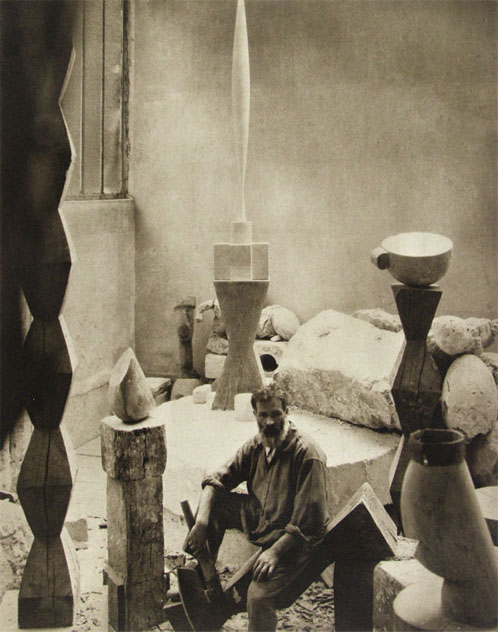
Constantin Brâncuşi; Photograph taken by Edward Steichen in 1922.
Born February 19, 1876(1876-02-19)
Hobiţa, Romania
Died March 16, 1957(1957-03-16) (aged 81)
Paris, France
Nationality Romanian
Field Sculpture
Training École des Beaux-Arts
Movement Modernism
Works Bird in Space, The Endless Column
Patrons John Quinn
Awards Romanian Academy


Constantin Brâncuşi

Constantin Brâncuşi Early years And Working in Paris

Constantin Brâncuşi (Romanian pronunciation: [konstanˈtin brɨnˈkuʃʲ]; February 19, 1876 – March 16, 1957) was a Romanian-born sculptor who made his career in France. As a child he displayed an aptitude for carving wooden farm tools. Formal studies took him first to Bucharest, then to Munich, then to the École des Beaux-Arts in Paris. His abstract style emphasizes clean geometrical lines that balance forms inherent in his materials with the symbolic allusions of representational art. Famous Brâncuşi works include the Sleeping Muse (1908), The Kiss (1908), Prometheus (1911), Mademoiselle Pogany (1913), The Newborn (1915), Bird in Space (1919) and The Column of the Infinite (Coloana infinitului), popularly known as The Endless Column (1938). Brâncuşi is considered a pioneer of modernism .

Early years

Brâncuşi grew up in the village of Hobiţa Romania, Gorj, near Târgu Jiu, near Romania's Carpathian Mountains, an area known for its rich tradition of folk crafts, particularly woodcarving. Geometric patterns of the region are seen in his later works.
Parents Nicolae and Maria Brâncuşi, were poor peasants who earned a meager living through back-breaking labor, and from the age of seven he herded the family's flock of sheep. He showed talent for carving objects out of wood and often ran away from home to escape the bullying of his father and older brothers.
At the age of nine, Brâncuşi left the village to work in the nearest large town. At 11 he went into the service of a grocer in Slatina; and then he became a domestic in a public house in Craiova where he remained for several years. When he was 18, impressed by Brâncuşi's talent for carving, an industrialist entered him in the Craiova School of Arts and Crafts (Şcoala de meserii), where he pursued his love for woodworking, graduating with honors in 1898.
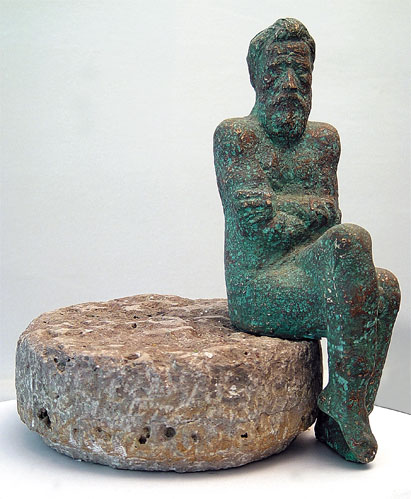
He then enrolled in the Bucharest School of Fine Arts, where he received academic training in sculpture. He worked hard, and quickly distinguished himself as talented. One of his earliest surviving works, under the guidance of his anatomy teacher, Dimitrie Gerota, is a masterfully rendered écorché (statue of a man with skin removed to reveal the muscles underneath) which was exhibited at the Romanian Athenaeum in 1903.Though just an anatomical study, it foreshadowed the sculptor's later efforts to reveal essence rather than merely copy outward appearance.

Working in Paris

In 1903 Brâncuşi traveled to Munich, and from there to Paris. In Paris, he was welcomed by the community of artists and intellectuals brimming with new ideas He worked for two years in the workshop of Antonin Mercié of the École des Beaux-Arts, and was invited to enter the workshop of Auguste Rodin. Even though he admired the eminent Rodin he left the Rodin studio after only two months, saying, "Nothing can grow under big trees."
After leaving Rodin's workshop, Brâncuşi began developing the revolutionary style for which he is known. His first commissioned work, "The Prayer", was part of a gravestone memorial. It depicts a young woman crossing herself as she kneels, and marks the first step toward abstracted, non-literal representation, and shows his drive to depict "not the outer form but the idea, the essence of things." He also began doing more carving, rather than the method popular with his contemporaries, that of modeling in clay or plaster which would be cast in metal, and by 1908 he worked almost exclusively by carving.
In the following few years he made many versions of "Sleeping Muse" and "The Kiss", further simplifying forms to geometrical and sparse objects.
BrancusiWorkng
His works became popular in France, Romania and the United States. Collectors, notably John Quinn, bought his pieces, and reviewers praised his works. In 1913 Brâncuşi's work was displayed at both the Salon des Indépendants and the first exhibition in the U.S. of modern art, the Armory Show.
In 1920 he developed a notorious reputation with the entry of "Princess X"  in the Salon. The phallic shape of the piece scandalized the Salon, and despite Brâncuşi's explanation that it was an anonymous portrait, removed it from the exhibition. "Princess X" was revealed to be Princess Marie Bonaparte, direct descendant of the younger brother of Napoleon Bonaparte. Brâncuşi represented or caricatured her life as a large gleaming bronze phallus. This phallus symbolizes the model's obsession with the penis and her lifelong quest to achieve vaginal orgasm, with the help of Sigmund Freud.
Around this time he began crafting the bases for his sculptures with much care and originality because he considered them important to the works themselves.
He began working on the group of sculptures that are known as "Bird in Space" — simple shapes representing a bird in flight. The works are based on his earlier "Măiastra" series. In Romanian folklore the Măiastra is a beautiful golden bird who foretells the future and cures the blind. Over the following 20 years, Brâncuşi would make 20-some versions of "Bird in Space" out of marble or bronze. Photographer Edward Steichen purchased one of the "birds" in 1926 and shipped it to the United States. However, the customs officers did not accept the "bird" as a work of art and placed a duty upon its import as an industrial item. They charged the high tax placed upon raw metals instead of the no tax on art. A trial the next year overturned the assessment. Athena Tacha Spear's book, Brâncuşi's Birds, (CAA monographs XXI, NYU Press, New York, 1969), first sorted out the 36 versions and their development, from the early Măiastra, to the Golden Bird of the late teens, to the Bird in Space, which emerged in the early '20s and which Brâncuşi perfected throughout his life.
His work became popular in the U.S., however, and he visited several times during his life. Worldwide fame in 1933 brought him the commission of building a meditation temple in India for Maharajah of Indore, but when Brâncuşi went to India in 1937 to complete the plans and begin construction, the Mahrajah was away and lost interest in the project when he returned.
In 1938, he finished the World War I monument in Tîrgu-Jiu where he had spent much of his childhood. "Table of Silence", "The Gate of the Kiss", and "Endless Column" commemorate the courage and sacrifice of

Romanian civilians who in 1916 fought off a German invasion. The restoration of this ensemble was spearheaded by the World Monuments Fund and was completed in 2004.
The Târgu Jiu ensemble marks the apex of his artistic career. In his remaining 19 years he created less than 15 pieces, mostly reworking earlier themes, and while his fame grew he withdrew. In 1956 Life magazine reported, "Wearing white pajamas and a yellow gnomelike cap, Brâncuşi today hobbles about his studio tenderly caring for and communing with the silent host of fish birds, heads, and endless columns which he created."
"The Endless Column" in Târgu Jiu, Romania, as restored after 2000


Brâncuşi was cared for in his later years by a Romanian refugee couple. He became a French citizen in 1952 in order to make the caregivers his heirs, and to bequeath his studio and its contents to the Musée National d'Art Moderne in Paris.